

Summary:
- The Theory of Change describes the desired transformative impact of a Community of Practice and the vision for how this change is expected to happen.
- Having a Theory of Change helps a Community of Practice gain clarity around its purpose, the lack of which is one of the most common reasons for failure.
- To craft a Theory of Change, start with defining goals and objectives, then choose appropriate metrics to measure the results.
Resources:
What is a Theory of Change?
A Theory of Change(ToC) is a description of how and why a desired change is expected to happen in a particular context. It focuses on mapping out the area between what a program or change initiative is trying to achieve and the activities or interventions that need to take place to ensure that the desired impact is achieved. It does this by first identifying the desired long-term goals and then works back from these to identify all the conditions (outcomes) that must be in place (and how these relate to one another causally) for the goals to occur.

It is a theory that says that if you want to achieve any goal or objective (outcomes and impact), you need to take certain actions (activities/inputs and outcomes). It is never framed in terms of “We need to take these actions to achieve these goals”. On the contrary, it is always defined with the objectives first, and the actions second, that is: “to achieve these goals, we need to take these actions.”
A very simple everyday example might be: I feel that I am not in great shape (the issue) and I need to lose weight (the goal), therefore I need to start eating less and exercising more (actions to achieve your goal). Another example might be a goal of improving literacy. To do this, the activities might be to increase the number of teachers and upgrade the infrastructure of schools. If this is not as successful as hoped for, the ToC might need to be altered to include ensuring that teachers are sufficiently trained.
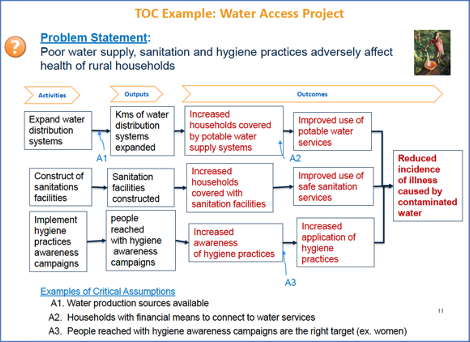
Why is it important to have a Theory of Change?
The Theory of Change is all about the goal or the problem to be solved and the activities that need to happen to effect that change. So a ToC really helps a Community of Practice (CoP) gain clarity around its purpose. And one of the most common reasons why CoPs fail, or never even really get going, is the lack of clarity around purpose.
In the same way you would never start a project without a ToC, you would never start a CoP without a ToC. If you do not know what your Community’s goal is, how can you design a set of activities to achieve that goal? Furthermore, if you do not achieve your goal, you can examine your ToC to see what did not work.
The ToC also helps you identify and distinguish between inputs, outputs and outcomes.
Inputs are something that you do; outputs are the result of that action. For example, an "input" might be a weekly working-out-loud (WOL) thread on an online platform; the "outputs” might include three comments and two likes this week, that is, not something you do, but an immediate result of something you do that's external (i.e. that members do).
Outcomes are what happens as a consequence of what you do. An output might be that 100 people attended this webinar; an outcome might be that after the webinar, 50% of attendees implemented the learnings in their day-to-day operations. Especially when reporting out, you want to tell the story of what results you are achieving and the impact you’re making, not so much how many people attended your webinar.
How do you create a Theory of Change for your Community?
There are several main stages to developing a Theory of Change. These include:
- Objectives: Clearly state the impact that you are trying to make.
- Results: Identify the results that you are trying to achieve – short, medium, and long term results. As results for development projects can take several years to reveal themselves, you should focus initially on immediate, short-term results.
- Outcomes: Define the outcomes that you want to see.
- Outputs: Define the outputs that lead to those desired outcomes.
- Inputs: Identify the activities, interventions and steps you need to take to achieve the outputs, outcomes, results and ultimately your final impact.
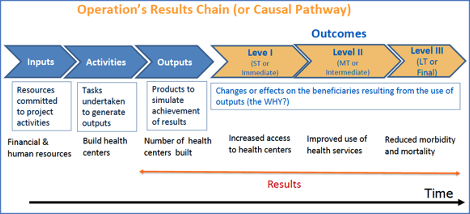
Note: There is a clear difference between outputs and outcomes. Outcomes are effects that the operation will have on the beneficiaries or organizations in terms of changed behavior or improved performance. It defines the operation’s effectiveness. The following table illustrates how inputs, outputs, and outcomes are related.
Inputs | Outputs | Outcomes |
Hours worked | Connections created | Solution sets created |
Blog posts written | Unique commenters | Projects impacted |
People invited | Discussions occurring | Practitioner hours saved |
Conversations initiated | Discussion depth | Support requests deflected |
Platform management | Documents shared | New business sourced |
Education budget | Number of schools built | Students skills improved |
Articles published | Number of documents read | Reader knowledge increased |
Indicators
One of the key elements in developing a Theory of Change is the choice of accurate and representative metrics or indicators. The indicators tell you whether your activities are producing successful results or not.
To select the most useful indicators, you must work with stakeholders and technical experts to determine which indicators are most appropriate and useful for management decisions. Where possible use existing indicators and use data that is easy to gather from available systems, for example, in education you might want to use published truancy rates if that is the issue you are addressing. A good “proxy” indicator is not the number of posts or number of meetings held but attendance at meetings held by the community. For example, if the majority of members are attending your meetings more than three times per year, it means that you are doing something right, you’re getting the right content to the right audience, who are engaging with it.
Tip: The first indicator you choose is good enough to start with. You might not be able to measure impact right away. Even if you can, impact takes time and you will have to assess impact in the short term, medium term, and long term. For example, you might be able to improve the teaching skills of your teachers, but it might take a much longer time to achieve the ultimate impact of improving reading levels of the students.
Examples of Inputs, Outputs, Outcomes, and Indicators
The following table shows examples of outputs, outcomes, and indicators.
Inputs | Outputs | Outcomes | Indicator |
Invite staff to join the CoP | Staff joining the CoP | Increased number of trainers/practitioners in WBG | Number of staff who join the CoP/year.
|
Hosting events – brown-bag lunches (BBLs), high level events | Number of events hosted
Number of participants | Increased level of support to client countries to implement reforms | The number of projects being supported by WBG trainers/practitioners |
New content posted on the CoP platforms | Files, documents downloaded | Knowledge of members increased | Number of files/articles shared
|
Developing publications and tools | Publications | Knowledge of members increased | Number of publications (recommend changing this to views and/or downloads) |
Courtesy of Patrick Kabuya, Senior Financial Management Specialist and Community Lead for the Integrated Reporting Community of Practice at WBG
Sample Indicators by Beneficiaries
As a final word about indicators, because outcomes are defined by the impact on beneficiaries, you can separate indicators and metrics according to different beneficiaries, most often, members, clients, and the organization or enterprise.
Note: There is often not just one outcome and one indicator or metric; you must also identify who or what benefits, as the following table shows:
Beneficiary | Indicator/Metric |
Members | Increase in knowledge Increase in work program Increase in reputation/position/advancement |
Clients (individuals and institutions) | Increase in adoption of reforms Increase in investment in programs Ability to tell a better story |
Organization | Improved ability to develop better programs Increase in number of programs in the pipeline |
