


Energy Efficiency in Buildings Community of Practice – Panel Discussion Summary
Date: 13 October 2025 | Platform: Zoom [Link to Recording]
This session, organized under the Energy Efficiency in Buildings Community of Practice, aimed to clarify how Energy Service Companies (ESCOs) and Energy Performance Contracts (EPCs) operate in practice and what lessons can be drawn for countries in the EU Neighbourhood, Western Balkans, Caucasus, and Central Asia. The objective was to “demystify” ESCO models—exploring what makes them successful, what risks they entail, and how they can be adapted to different market and policy contexts.
Key Takeaways
- EPCs are viable and adaptable – Successful models exist across both public and residential sectors, but must be tailored to national legal, financial, and institutional contexts.
- Trust and stability are crucial – Long-term client relationships, especially in the public sector, underpin viable contracts; in residential markets, extensive community engagement is essential.
- Access to affordable finance remains the main bottleneck – Public or blended finance facilities, such as Armenia’s R2E2 Fund, can play a catalytic role in crowding in private investment and scaling projects.
- Clear regulatory frameworks enable growth – Simplified public procurement procedures, clarified debt treatment, and standardized EPC templates are key to reducing risk and increasing uptake.
- Start small, demonstrate success, and build momentum – Pilot projects with visible results (“low-hanging fruits”) help raise awareness, build institutional trust, and attract replication and policy support.
Panel Participants
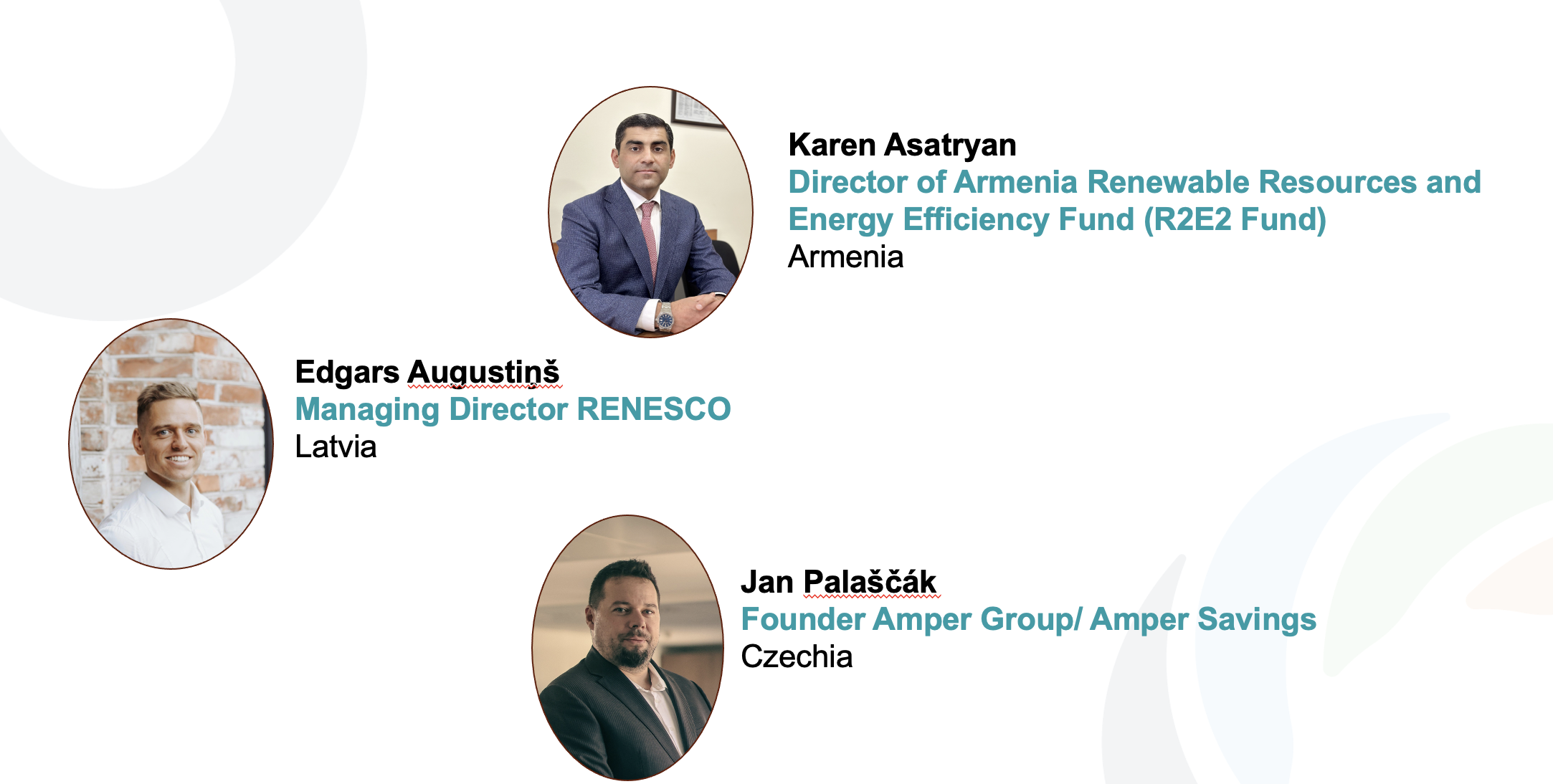
Question 1: Please introduce your company and main achievements regarding EPCs
Karen Asatryan (Armenia R2E2 Fund):
Established by the Armenian government in 2006, the R2E2 Fund supports public and private investment in energy efficiency and renewable energy. The Fund has implemented EE projects in 120+ public buildings, including street lighting, hospitals, and schools, mobilizing over USD 10 million in financing (World Bank, E5P, GCF). Armenia’s model blends public financing with EPC principles, ensuring repayment through verified energy savings.Edgars Augustiņš (RENESCO, Latvia):
RENESCO operates in privately owned multi-apartment buildings, offering deep renovation packages covering insulation, heating, and ventilation systems. It has retrofitted 16 buildings achieving 40–60% energy savings. RENESCO pioneered shared-savings and guaranteed savings EPC models, fully financing the renovation and recovering costs over 20 years from verified energy savings.Jan Palaščák (Amper Savings, Czechia):
Amper Savings evolved from Amper Group’s experience in renewables and energy trading. It has implemented dozens of EPC projects, mainly in hospitals and public institutions, combining energy management with performance contracting. Jan described EPCs as “the best of all energy products” — a long-term partnership model integrating design, construction, and energy management.
Question 2: How are risks shared and mitigated in your EPC model?
Jan Palaščák (Amper Savings, Czechia):
The key to risk mitigation lies in selecting stable, long-term clients, typically public entities such as hospitals or municipalities. Amper Savings shoulders technical and performance risks, while clients benefit from guaranteed savings. The importance of demystifying EPCs was highlighted: even in professional circles, the concept is often misunderstood. For Amper Savings, trust, transparency, and project preparation are the foundations for success.- Edgars Augustiņš (RENESCO, Latvia):
RENESCO bears the technical and financing risk by funding the renovation upfront. Risk mitigation includes:- Pre- and post-retrofit energy audits and robust monitoring (temperature, indoor comfort, energy use).
- Maintenance responsibility throughout the 20-year contract.
- Three party agreements between residents, utilities, and RENESCO to ensure stable cash flow.
The main challenge lies in decision-making among hundreds of homeowners, often taking up to two years of community engagement before contract signing.
- Karen Asatryan (Armenia R2E2 Fund):
The R2E2 Fund manages risk through comprehensive due diligence of public institutions’ financial capacity before contracting.- Each beneficiary must include repayment lines in their annual budget.
- Payments are withheld until post-retrofit monitoring and verification confirm achieved savings.
- The Fund provides financing at low interest rates, with project payback limited to 8–10 years to ensure financial feasibility.
Question 3: How do you access financing for EPC projects?
- Edgars Augustiņš (RENESCO, Latvia):
Initial projects were financed through owners’ equity and Dutch social investment funds, later complemented by commercial bank loans once lenders recognized the strong repayment record. RENESCO now explores securitization of future cash flows and access to public loans for energy efficiency using EPC. Despite success, high investment costs and lack of sustainable financing remain a bottleneck. - Karen Asatryan (Armenia R2E2 Fund):
Operates as a publicly funded financial intermediary, channeling concessional financing (World Bank, GCF) to public buildings. The Fund acts as an ESCO itself, offering turnkey services (audit, design, construction, monitoring) and on-lending repayments from achieved savings. - Jan Palaščák (Amper Savings, Czechia):
Uses a hybrid financing model combining company capital, energy trading revenues, and external finance. Public sector clients’ credit stability enables long-term financing. Jan underlined that policy clarity — especially around public debt accounting (Maastricht rules) — was critical; the Czech government’s recent clarification unblocking EPC classification as non-debt was a major enabler.
Question 4: What are typical contract durations and responsibilities for operation & maintenance (O&M)?
- Jan Palaščák (Amper Savings, Czechia):
- Duration: 5–7 years for single-technology projects; ~10 years for complex building retrofits.
- O&M is fully integrated — Amper manages installed systems and energy performance throughout the contract.
- Edgars Augustiņš (RENESCO, Latvia):
- Duration: 20 years, with O&M and long-term maintenance provided by RENESCO.
- The company guarantees comfort levels (indoor temperature) and savings.
- Typical project values remain modest, reflecting RENESCO’s social enterprise model— reinvesting profits into maintaining building quality.
- Karen Asatryan (Armenia R2E2 Fund):
- Duration: up to 10 years for savings agreements; retrofit phase typically 1–1.5 years.
- Equipment warranties last five years, with one year of performance monitoring post-completion.
- Contractors provide training to facility staff for ongoing operation.
Question 5: Lessons learned and recommendations
Jan Palaščák (Amper Savings, Czechia):
- EPCs represent “the business of the future” — the most sustainable element of any national energy strategy.
- EPC projects are a robust and proven method: we just need to remove regulatory burdens and make them for clients in both the private and public sectors as cool as they truly are.
- Energy efficiency should be treated as the first pillar of energy transition, equal to renewables.
Edgars Augustiņš (RENESCO, Latvia):
- Do not rely on rising energy prices to make projects viable; build models resilient to market fluctuations.
- Stable public co-financing frameworks are essential — unpredictable subsidy cycles distort markets.
- Engage residents continuously to build trust and avoid “boom-and-bust” renovation patterns.
- Regulatory environments should enable long-term contracting and blended financing.
Karen Asatryan (Armenia R2E2 Fund):
- Start with government endorsement and awareness campaigns to build institutional trust.
- Use cheap or public capital to demonstrate early success (“low-hanging fruit” projects).
- Engage private companies for technology and implementation know-how.
- Success depends on measurable, visible results that inspire replication and policy support.
Wrap-Up
ESCOs can work across public and residential sectors when financial, legal, and trust frameworks align. The model is viable, scalable, and essential for meeting the region’s energy efficiency and climate goals.
