


About the Program
From September 7 to 10, 2026, Vienna became a hub for practitioners working at the intersection of climate science and locally led approaches for better jobs and resilient development. Co-led by GeoSphere Austria and the World Bank’s Platform for Locally Led Climate Action, the Vienna Practitioners’ Program brought together government delegations, implementing agencies, and World Bank operational teams from 16 projects across Africa, Central Asia, East Asia and the Pacific, and Europe. The program was hosted at the Vienna Development Knowledge Center (VDKC) and made possible through financing from the Nordic Development Fund.

Building on earlier webinars and virtual exchanges, the January 2026 Global Knowledge Exchange in Jakarta, and the November 2025 VDKC-supported workshop From the Ground Up: Locally Led Responses Bridging Climate, Livelihoods and Resilience, the Vienna Practitioners’ Program marked the next stage in a broader learning journey on locally led climate action. Shifting from peer exchange toward structured, application-oriented and technical learning, it focused on a central challenge shared by practitioners across the group: how to translate complex climate data into decisions that communities can own and act on. Over four intensive days, participants gained an in-depth understanding of Austria’s experience in using climate data to support locally led, climate-smart development. They also learned from one another’s experiences and received targeted technical guidance to help address the real-world challenges they face in their day-to-day operations.
A Four-Day Learning Journey
- Day 1 set the foundation by exploring how climate risks affect communities differently depending on local context, and why decentralized, locally owned systems are essential to effective climate action. The sessions highlighted a recurring theme: technical information is only useful when it reaches the right people, in a form they can act on.
- Day 2 introduced a structured four-step climate risk assessment methodology — defining scope, building impact chains, analyzing hazards and vulnerabilities, and evaluating risk thresholds. Through a ‘country carousel’, participants learned about one another’s programs, exchanged practical lessons, and reflected on how successful tools and methods could be adapted to their own country contexts.
- Day 3 put knowledge into action. GeoSphere Austria led a multi-hazard simulation exercise in which participants stepped into different institutional roles to negotiate real-world trade-offs. The afternoon’s project clinics allowed teams to work through specific implementation challenges with peers and GeoSphere experts.


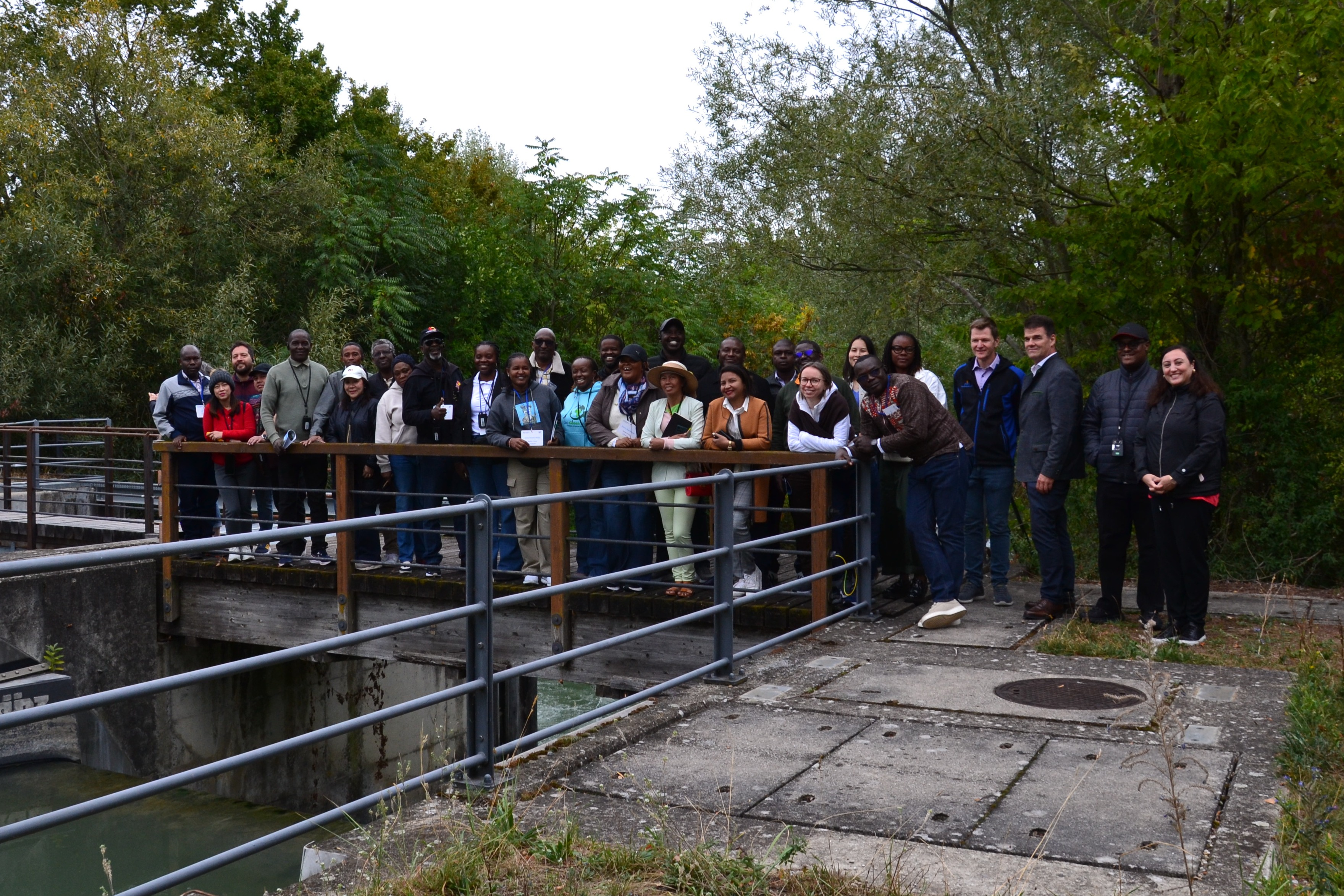
- Day 4 took participants into the field. Four site visits offered concrete examples of locally led climate action across different sectors:
- Marchfeld Canal Operating Company — resilient water infrastructure and multi-actor coordination in practice Repair & Service Center R.U.S.Z. — a circular economy model combining environmental impact with social inclusion.
- Renewable Energy Community Tattendorf — community ownership and governance of locally appropriate renewable energy solutions, including a low-impact mini-hydro turbine designed to maintain fish passage.
- Forestgarden Community Supported Agriculture — climate-smart land management integrating food production and ecological resilience.


Takeaways
During the closing reflection and synthesis, participants connected the program’s frameworks, exercises, peer exchanges, and field visits to their own operational contexts. They explored how to turn technical climate data into actionable information, negotiate priorities under uncertainty, and apply locally led approaches in their projects.
A consistent message emerged: effective climate action depends not only on infrastructure and investment, but also on local ownership, trusted institutions, cross-sector coordination, sustainable financing, and the relationships and skills needed for lasting implementation. Participants also strengthened connections with peers and technical partners who can support continued problem-solving and exchange.
Participant reflections capture these takeaways:
“Having data is not enough; it must be transformed into action.”
“Communities have the power to develop and maintain climate-sensitive solutions, if organized and supported at the start.”
What Comes Next
The Vienna Program is a stepping stone, not an endpoint. Participants expressed strong interest in continued engagement, particularly on climate data, climate risk assessment, community-level resilience, and monitoring and evaluation. The vision is to continue building a sustained learning community through the Locally Led Climate Action platform, to help practitioners turn knowledge into action, share practical experience, and strengthen resilience across countries.
To learn more about the program, read the full report and the article, Combining Data, Local Knowledge, and Action for Stronger Climate Resilience.

Learn more about the Platform for Locally Led Climate Action
